pyfar.dsp.fft
The discrete Fourier spectrum of an arbitrary, but band-limited signal
 is defined as
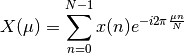
using a negative sign convention in the transform kernel
 .
Analogously, the discrete inverse Fourier transform is implemented as
.
Analogously, the discrete inverse Fourier transform is implemented as
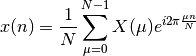
Pyfar uses a DFT implementation for purely real-valued time signals resulting
in Fourier spectra with complex conjugate symmetry for negative and
positive frequencies  . As a result,
the left-hand side of the spectrum is discarded, yielding
. As a result,
the left-hand side of the spectrum is discarded, yielding
 . Complex valued
time signals can be implemented, if required.
. Complex valued
time signals can be implemented, if required.
Normalization 1
pyfar implements five normalization that can be applied to spectra. The
normalizations are available from normalization. Note that the time
signals do not change regardless of the normalization.
Energy Signals
For energy signals with finite energy,
such as impulse responses, no normalization is required, that is
the spectrum of a energy signal is equivalent to the right-hand spectrum
of a real-valued time signal defined above. The coresponding normalization is
'none'.
Power Signals
For power signals however, which possess a finite power but infinite energy,
a normalization for the time interval in which the signal is sampled, is
chosen. In order for Parseval’s theorem to remain valid, the single sided
needs to be multiplied by a factor of 2, compensating for the discarded part
of the spectrum (cf. 1, Eq. 8). The coresponding normalization is
'unitary'. Additional normalizations can be applied to further scale the
spectrum, e.g., according to the RMS value.
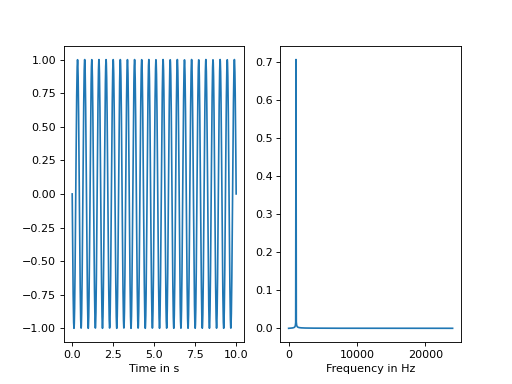
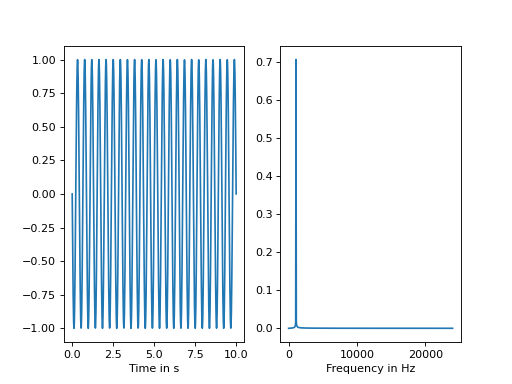
>>> import numpy as np
>>> from pyfar.dsp import fft
>>> import matplotlib.pyplot as plt
>>> # properties
>>> fft_normalization = "rms"
>>> n_samples = 1024
>>> sampling_rate = 48e3
>>> frequency = 100
>>> times = np.linspace(0, 10, n_samples)
>>> freqs = fft.rfftfreq(n_samples, 48e3)
>>> # generate data
>>> sine = np.sin(times * 2*np.pi * frequency)
>>> spec = fft.rfft(sine, n_samples, sampling_rate, fft_normalization)
>>> # plot time and frequency data
>>> plt.subplot(1, 2, 1)
>>> plt.plot(times, sine)
>>> ax = plt.gca()
>>> ax.set_xlabel('Time in s')
>>> plt.subplot(1, 2, 2)
>>> plt.plot(freqs, np.abs(spec))
>>> ax = plt.gca()
>>> ax.set_xlabel('Frequency in Hz')
>>> plt.show()
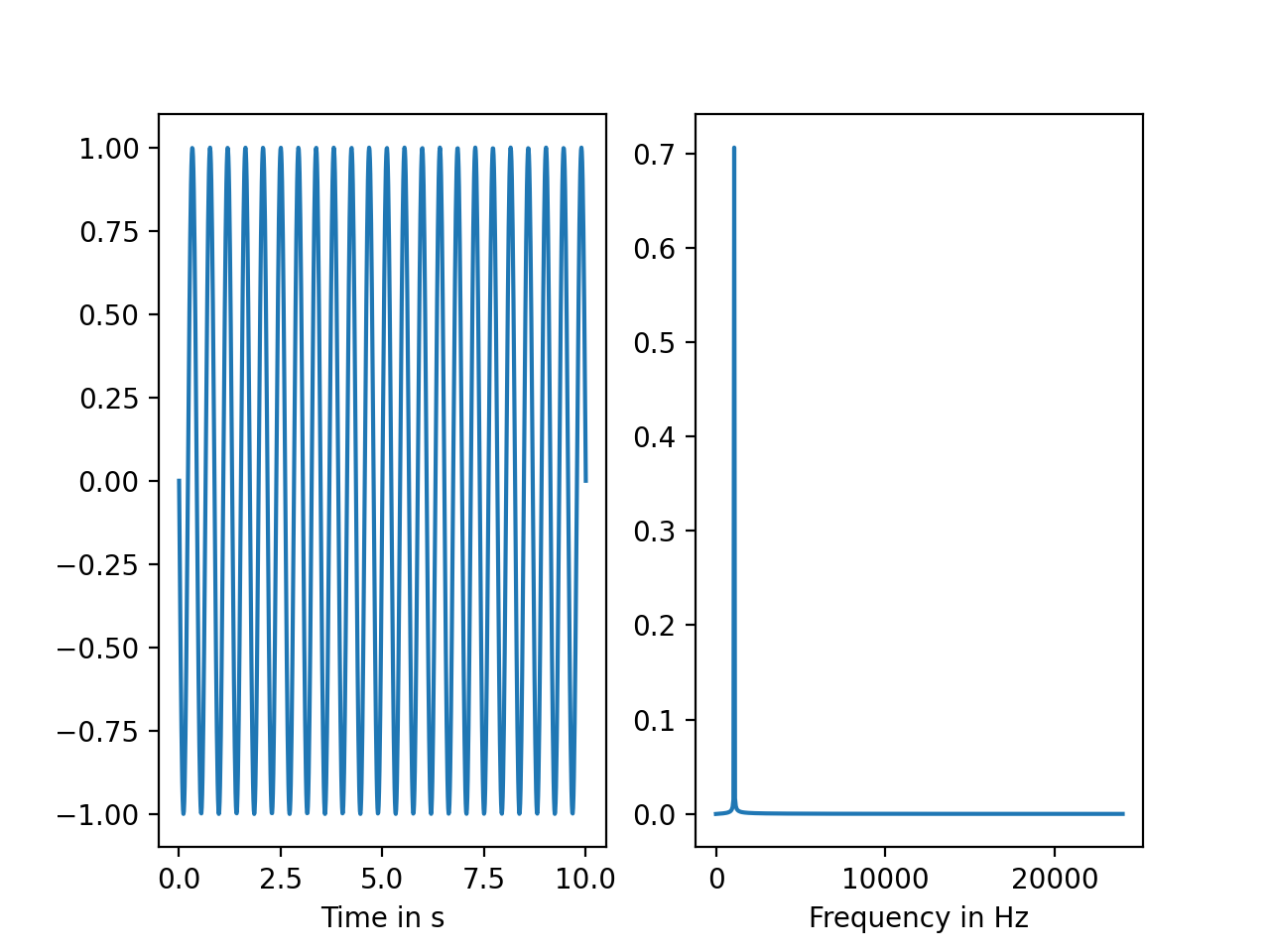
(Source code, png, hires.png, pdf)
References
- 1(1,2,3,4,5,6,7,8,9,10)
J. Ahrens, C. Andersson, P. Höstmad, and W. Kropp, “Tutorial on Scaling of the Discrete Fourier Transform and the Implied Physical Units of the Spectra of Time-Discrete Signals,” Vienna, Austria, May 2020, p. e-Brief 600.
Functions:
|
Calculate the IFFT of a axis-symmetric Fourier spectum. |
|
Normalize spectrum. |
|
Calculate the FFT of a real-valued time-signal. |
|
Returns the positive discrete frequencies in the range |
- pyfar.dsp.fft.irfft(spec, n_samples, sampling_rate, fft_norm)[source]
Calculate the IFFT of a axis-symmetric Fourier spectum. The function takes only the right-hand side of the spectrum and returns a real-valued time signal. The normalization distinguishes between energy and power signals. Energy signals are not normalized by their number of samples. Power signals are normalized by their effective value as well as compensated for the missing energy from the left-hand side of the spectrum. This ensures that the energy of the time signal and the right-hand side of the spectrum are equal and thus fulfill Parseval’s theorem.
- Parameters
spec (array, complex) – The complex valued right-hand side of the spectrum with dimensions (…, n_bins)
n_samples (int) – The number of samples in the corresponding tim signal. This is crucial to allow for the correct transform of time signals with an odd number of samples.
sampling_rate (number) – sampling rate in Hz
fft_norm ('unitary', 'amplitude', 'rms', 'power', 'psd') – See documentaion of
normalization.
- Returns
data – Array containing the time domain signal with dimensions (…, n_samples)
- Return type
array, double
- pyfar.dsp.fft.normalization(spec, n_samples, sampling_rate, fft_norm='none', inverse=False, single_sided=True, window=None)[source]
Normalize spectrum.
Apply normalizations defined in 1 to the DFT spectrum. Note that, the phase is maintained in all cases, i.e., instead of taking the squared absolute values in Eq. (5-6), the complex spectra are multiplied with their absolute values.
- Parameters
spec (numpy array) – N dimensional array which has the frequency bins in the last dimension. E.g.,
spec.shape == (10,2,129)holds 10 times 2 spectra with 129 frequency bins each.n_samples (int) – number of samples of the corresponding time signal
sampling_rate (number) – sampling rate of the corresponding time signal in Hz
fft_norm (string, optional) –
- ‘none’
Do not apply any normalization
- ’unitary’
Multiplied single sided spectra by factor two as in 1 Eq. (8) (except for 0 Hz and the Nyquist frequency at half the sampling rate)
- ’amplitude’
scale spec by
1/n_samplesas in 1 Eq. (4)- ’rms’
scale spec by
 as in 1 Eq. (10)
- ’power’
scale the power spectrum by
1/n_samples**2as in 1 Eq. (5)- ’psd’
scale the power spectrum by
1/(sampling_rate * n_samplesas in 1 Eq. (6)
Note that the unitary normalization is also applied for amplitude, rms, power, and psd if the input spectrum is single sided (See below).
inverse (bool, optional) – apply the inverse normalization. The default is
False.single_sided (bool, optional) – denotes if spec is a single sided spectrum up to half the sampling rate or a both sided (full) spectrum. If
single_sided=Truethe normalization according to 1 Eq. (8) is unlessfft_norm='none'. The default isTrue.window (None, array like) – window that was applied to the time signal before performing the FFT. window must be an array like with n_samples and affects the normalization as in 1 Eqs. (11-13). The default is
None, which denotes that no window was applied.
- Returns
spec – normalized input spectrum
- Return type
numpy array
- pyfar.dsp.fft.rfft(data, n_samples, sampling_rate, fft_norm)[source]
Calculate the FFT of a real-valued time-signal. The function returns only the right-hand side of the axis-symmetric spectrum. The normalization distinguishes between energy and power signals. Energy signals are not normalized in the forward transform. Power signals are normalized by their number of samples and to their effective value as well as compensated for the missing energy from the left-hand side of the spectrum. This ensures that the energy of the time signal and the right-hand side of the spectrum are equal and thus fulfill Parseval’s theorem.
- Parameters
data (array, double) – Array containing the time domain signal with dimensions (…, n_samples)
n_samples (int) – The number of samples
sampling_rate (number) – sampling rate in Hz
fft_norm ('unitary', 'amplitude', 'rms', 'power', 'psd') – See documentation of
normalization.
- Returns
spec – The complex valued right-hand side of the spectrum with dimensions (…, n_bins)
- Return type
array, complex
- pyfar.dsp.fft.rfftfreq(n_samples, sampling_rate)[source]
Returns the positive discrete frequencies in the range
![[0, \text{sampling\_rate}/2]](_images/math/081bd57b1090664e6891ee2b475c2eabea1e0335.png) for which the FFT of a real valued
time-signal with n_samples is calculated. If the number of samples
for which the FFT of a real valued
time-signal with n_samples is calculated. If the number of samples
 is even the number of frequency bins will be
  , if
is odd, the number of bins will be
, if
is odd, the number of bins will be  .
.- Parameters
n_samples (int) – The number of samples in the signal
sampling_rate (int) – The sampling rate of the signal
- Returns
frequencies – The positive discrete frequencies in Hz for which the FFT is calculated.
- Return type
array, double