
pyfar.constants#
Module for constants and physical properties of air.
Constants:
- pyfar.constants.absolute_zero_celsius: Final[float] = -273.15#
Absolute zero temperature \(\mathrm{t_0}\) in degree Celsius [1].
\[t_0 = -273.15 \text{°C}\]- Returns:
t_0 – Absolute zero temperature in degree Celsius.
- Return type:
float
References
- pyfar.constants.reference_air_density: Final[float] = 1.204#
Reference air density in \(\text{kg}/\text{m}^3\) at reference atmospheric pressure and 20°C [2].
\[\rho_\text{atm} = 1.204 \, \frac{\text{kg}}{\text{m}^3}\]- Returns:
Reference air density in \(\text{kg}/\text{m}^3\).
- Return type:
float
References
- pyfar.constants.reference_air_impedance: Final[float] = 413.21279999999996#
Reference air impedance \(Z_\text{ref}\) in Pa s/m is calculated based on
reference_speed_of_soundandstandard_air_density.\[Z_\text{ref} = \rho_\text{atm} \cdot c_\text{ref} \approx 413.2 \, \text{Pa s/m}\]- Returns:
Z_ref – Reference air impedance in Pa s/m.
- Return type:
float
- pyfar.constants.reference_air_temperature_celsius: Final[float] = 20#
Reference air temperature \(t_\text{ref}\) in degree Celsius [3].
\[t_\text{ref} = 20 \text{°C}\]- Returns:
t_ref – Reference air temperature in degree Celsius.
- Return type:
float
References
- pyfar.constants.reference_atmospheric_pressure: Final[float] = 101325.0#
Reference atmospheric pressure \(P_\text{atm}\) in Pascal [4].
\[P_\text{atm} = 101325 \, \text{Pa}\]- Returns:
Reference atmospheric pressure in Pascal.
- Return type:
float
References
- pyfar.constants.reference_sound_power: Final[float] = 1e-12#
Reference sound power \(P_\text{ref}\) in Watt [5].
\[P_\text{ref} = 1 \, \text{pW} = 10^{-12} \, \text{W}\]- Returns:
P_ref – Reference sound power in Watt.
- Return type:
float
References
- pyfar.constants.reference_sound_pressure: Final[float] = 2e-05#
Reference sound pressure \(p_\text{ref}\) in Pascal [6].
\[p_\text{ref} = 20 \, \mathrm{\mu Pa}\]- Returns:
p_ref – Reference sound pressure in Pascal.
- Return type:
float
References
- pyfar.constants.reference_speed_of_sound: Final[float] = 343.2#
Reference speed of sound \(c_\text{ref}\) in m/s for 20°C and dry air [7].
\[c_\text{ref} = 343.2 \, \text{m/s}\]- Returns:
c_ref – Reference speed of sound in m/s.
- Return type:
float
References
Functions:
|
Calculate the pure tone attenuation of sound in air according to ISO 9613-1. |
|
Calculate the density of air in kg/m³ based on the temperature, relative humidity, and atmospheric pressure. |
Calculate the tolerance limits for fractional octave band filters. |
|
Return the exact center and cutoff frequencies for fractional-octave-band filters. |
|
Return the nominal center frequencies for octave-band and one-third-octave-band filters. |
|
Returns the A or C frequency weighting correction values for octave or third-octave bands in a given frequency range. |
|
|
Calculates the level correction in dB of each frequency component when using the A or C frequency weighting. |
|
Calculate the saturation vapor pressure of water in Pascal using the Magnus formula. |
|
Calculate the speed of sound in air based on temperature, atmospheric pressure, humidity and CO2 concentration. |
|
Calculate speed of sound in air using the ideal gas law. |
|
Calculate the speed of sound in air using a simplified version of the ideal gas law based on the temperature. |
- pyfar.constants.air_attenuation(temperature, frequencies, relative_humidity, atmospheric_pressure=None)[source]#
Calculate the pure tone attenuation of sound in air according to ISO 9613-1.
Calculation is in accordance with ISO 9613-1 [8]. The shape of the outputs is broadcasted from the shapes of the
temperature,relative_humidity, andatmospheric_pressure. The frequency bins represents the last dimension.- Parameters:
temperature (float, array_like) – Temperature in °C. Must be in the range of -20 °C to 50 °C for accuracy of +/-10% or must be greater than -70 °C for accuracy of +/-50%.
frequencies (float, array_like) – Frequency in Hz. Must be greater than 50 Hz. Just one dimensional array is allowed.
relative_humidity (float, array_like) – Relative humidity in the range from 0 to 1.
atmospheric_pressure (float, array_like, optional) – Atmospheric pressure in Pascal, by default
reference_atmospheric_pressure.
- Returns:
alpha (np.ndarray[float]) – Pure tone air attenuation coefficient in dB/m for atmospheric absorption.
m (
FrequencyData) – Pure tone energy attenuation coefficient in 1/m for atmospheric absorption. The parametermis calculated as \(m = \alpha / (10 \log_{10}(e))\).accuracy (
FrequencyData) – accuracy of the results according to the standard:10, +/- 10% accuracymolar concentration of water vapour: 0.05% to 5%.
air temperature: 253.15 K to 323.15 K (-20 °C to +50 °C)
atmospheric pressure: less than 200 000 Pa (2 atm)
frequency-to-pressure ratio: 0.0004 Hz/Pa to 10 Hz/Pa.
20, +/- 20% accuracymolar concentration of water vapour: 0.005% to 0.05%, and greater than 5%
air temperature: 253.15 K to 323.15 K (-20 °C to +50 °C)
atmospheric pressure: less than 200 000 Pa (2 atm)
frequency-to-pressure ratio: 0.0004 Hz/Pa to 10 Hz/Pa.
50, +/- 50% accuracymolar concentration of water vapour: less than 0.005%
air temperature: greater than 200 K (- 73 °C)
atmospheric pressure: less than 200 000 Pa (2 atm)
frequency-to-pressure ratio: 0.0004 Hz/Pa to 10 Hz/Pa.
-1, no valid resultelse.
References
- pyfar.constants.density_of_air(temperature, relative_humidity, atmospheric_pressure=None, saturation_vapor_pressure=None)[source]#
Calculate the density of air in kg/m³ based on the temperature, relative humidity, and atmospheric pressure.
The density of air is calculated based on chapter 6.3 in [9]. All input parameters must be broadcastable to the same shape.
- Parameters:
temperature (float, array_like) – Temperature in degrees Celsius (°C).
relative_humidity (float, array_like) – Relative humidity in the range from 0 to 1.
atmospheric_pressure (float, array_like, optional) – Atmospheric pressure in Pascal (Pa), by default
reference_atmospheric_pressure.saturation_vapor_pressure (float, array_like, optional) – Saturation vapor pressure in Pascal (Pa). The default uses the value and valid temperature range from
saturation_vapor_pressure_magnus.
- Returns:
density – Density of air in kg/m³.
- Return type:
float, array_like
References
- pyfar.constants.fractional_octave_filter_tolerance(exact_center_frequency: float, num_fractions: Literal[1, 3], tolerance_class: Literal[1, 2])[source]#
Calculate the tolerance limits for fractional octave band filters.
Calculation is in accordance with IEC 61260-1:2014 [10] (Section 5.10 and Table 1).
Note
The standard defines some lower tolerance limits as \(-\infty\), which is inconvenient for plotting. The returned tolerance is -60000 dB in these cases, which is below the smallest possible value of
20*np.log10(np.finfo(float).tiny\(\approx\)-6000 dB.- Parameters:
exact_center_frequency (float) – The exact center frequency of the band filter in Hz (see
fractional_octave_frequencies).num_fractions (Literal[1, 3]) – The number of bands an octave is divided into.
1for octave bands and3for third octave bands.tolerance_class (Literal[1, 2]) – The tolerance class as defined in the standard. Must be
1or2.
- Returns:
lower_tolerance (numpy array) – Lower tolerance limits in dB of shape (19, ).
upper_tolerance (numpy array) – Upper tolerance limits in dB of shape (19, ).
frequencies (numpy array) – The frequencies in Hz at which the tolerance is given of shape (19, ).
References
Examples
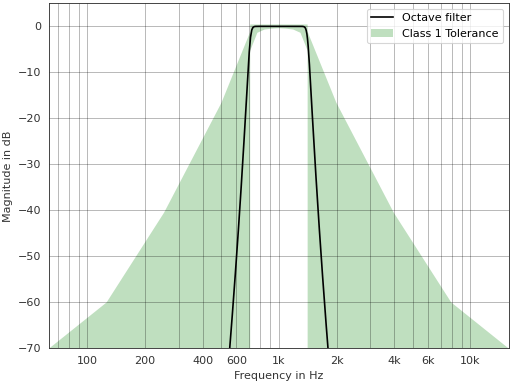
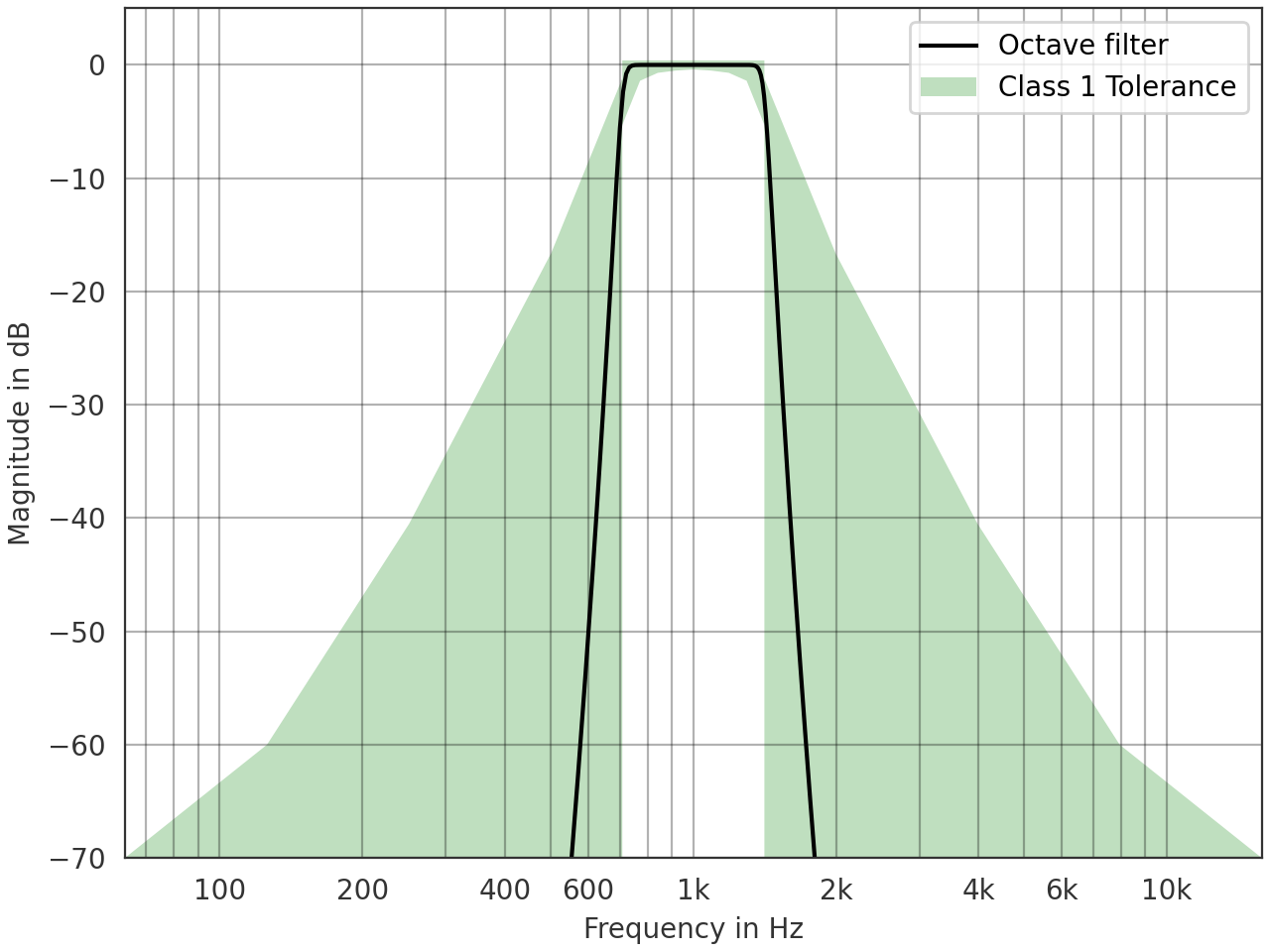
Class 1 tolerance region and filter for the 1000 Hz octave band.
>>> import pyfar as pf
>>> import matplotlib.pyplot as plt
>>>
>>> lower, upper, frequencies = \
...     pf.constants.fractional_octave_filter_tolerance(
...         exact_center_frequency=1000, num_fractions=1,
...         tolerance_class=1)
>>>
>>> octave_filter = pf.dsp.filter.fractional_octave_bands(
...     pf.signals.impulse(2**12), num_fractions=1,
...     frequency_range=(1000, 1000))
>>>
>>> ax = pf.plot.freq(octave_filter, color='k', label='Octave filter')
>>> plt.fill_between(
...     frequencies, lower, upper,
...     facecolor='g', alpha=.25, label='Class 1 Tolerance')
>>> ax.set_ylim(-70, 5)
>>> ax.set_xlim(63, 15_850)
>>> ax.legend()
(
Source code,png,hires.png,pdf)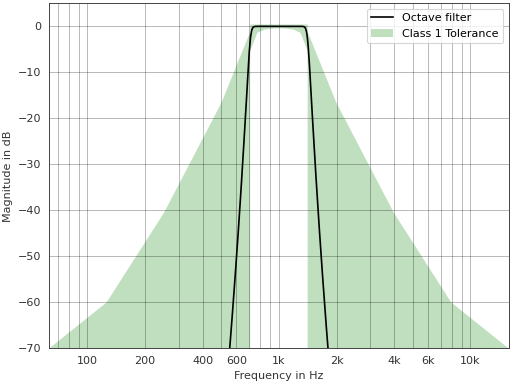
- pyfar.constants.fractional_octave_frequencies_exact(num_fractions: int = 1, frequency_range: tuple[float, float] = (20, 20000.0))[source]#
Return the exact center and cutoff frequencies for fractional-octave-band filters.
The frequencies are calculated in accordance with the IEC 61260-1:2014 standard [11] (Sections 5.2, 5.3, 5.4 and 5.6).
The octave frequency ratio, \(G\), is given by the following expression.
\[G = 10^{\tfrac{3}{10}}\]The center frequencies \(f_m\) are calculated using formula (1) for odd values of \(b\) and formula (2) for even values of \(b\).
(1)#\[f_m = f_r \cdot G^{ \tfrac{x}{b}}\](2)#\[f_m = f_r \cdot G^{ \tfrac{2x+1}{2b}}\]where:
\(b\) is the number of octave fractions.
\(f_r\) is the reference frequency, set to 1000 Hz.
\(x\) is the index of the frequency band.
- Parameters:
num_fractions (int, optional) – The number of bands an octave is divided into. E.g.,
1refers to octave bands and3to third octave bands. The default is1. All positive integers are allowed.frequency_range (array, tuple) – The lower and upper frequency limits, the default is
(20, 20e3).
- Returns:
center_frequencies (numpy.ndarray) – The exact center frequencies in Hz of the bandpass filters for each fractional octave band.
lower_cutoff_frequencies (numpy.ndarray) – The lower cutoff frequencies in Hz of the bandpass filters for each fractional octave band.
upper_cutoff_frequencies (numpy.ndarray) – The upper cutoff frequencies in Hz of the bandpass filters for each fractional octave band.
References
Notes
The specified
frequency_rangeis interpreted as frequencies lying within (fractional) octave bands defined by their cutoff frequencies (not their center frequencies). All bands that overlap with the specified frequency range are returned.
- pyfar.constants.fractional_octave_frequencies_nominal(num_fractions: Literal[1, 3] = 1, frequency_range: tuple[float, float] = (20, 20000.0))[source]#
Return the nominal center frequencies for octave-band and one-third-octave-band filters.
Nominal center frequencies, as specified in the IEC 61260-1:2014 standard [12] (Section 5.5 and Annex E), are standardized values that approximate the exact center frequencies. They are defined from 10 Hz to 20 kHz.
- Parameters:
num_fractions ({1, 3}) – The number of octave fractions.
1returns octave center frequencies,3returns third-octave center frequencies. The default is1.frequency_range (array, tuple) – The lower and upper frequency limits, the default is
(20, 20e3)following IEC 61260-1. E.g.(10, 20e3)would follow IEC 61672-1 [13].
- Returns:
nominal – The nominal center frequencies.
- Return type:
numpy.ndarray of float
Notes
The specified
frequency_rangeis interpreted as frequencies lying within (fractional) octave bands defined by their cutoff frequencies (not their center frequencies). All bands that overlap with the specified frequency range are returned.References
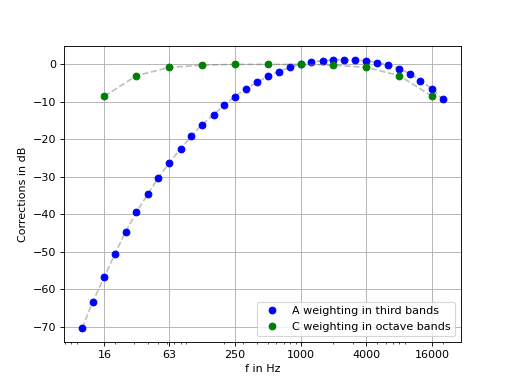
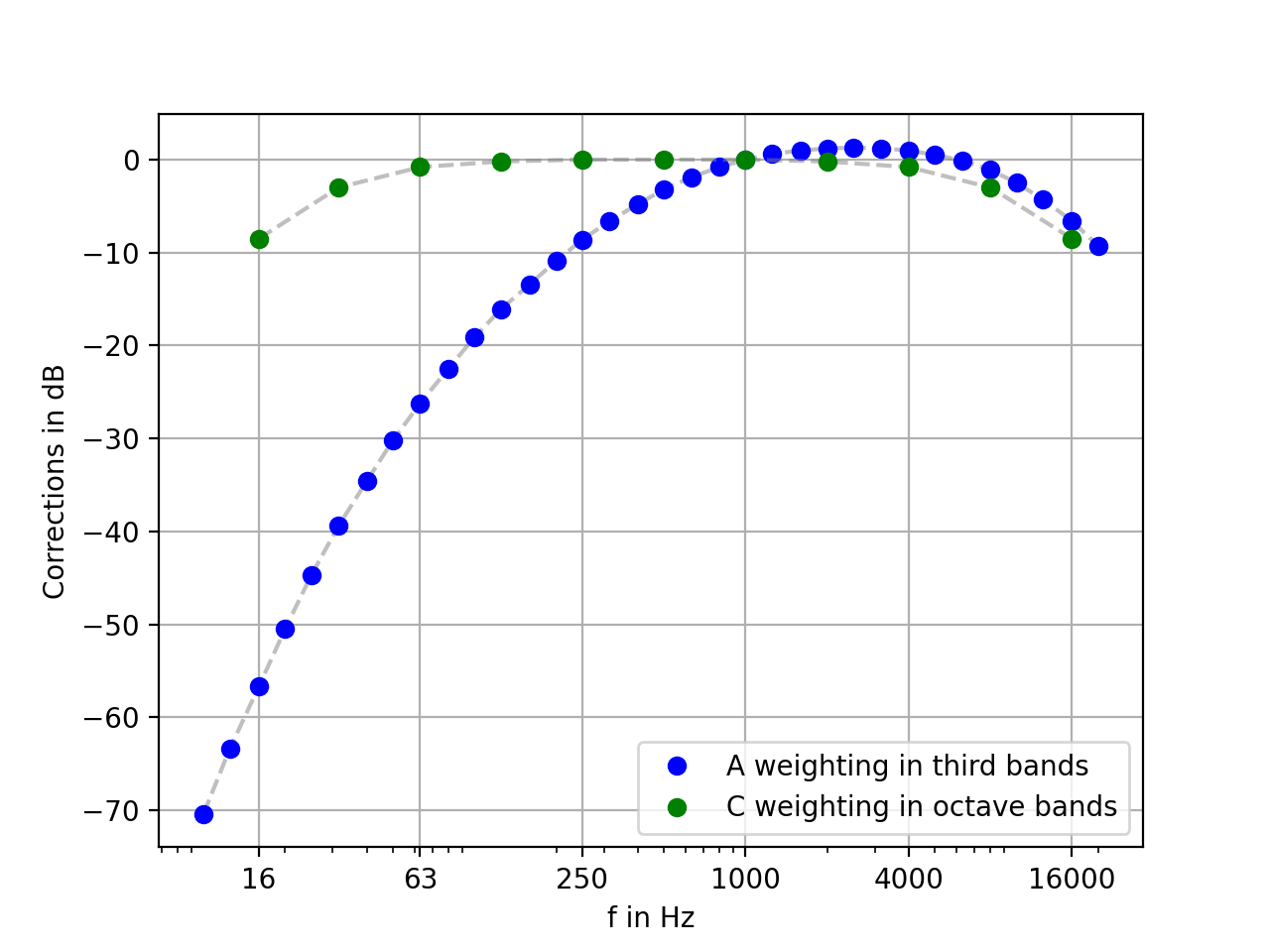
- pyfar.constants.frequency_weighting_band_corrections(weighting: Literal['A', 'C'], num_fractions: Literal[1, 3], frequency_range: tuple[float, float])[source]#
Returns the A or C frequency weighting correction values for octave or third-octave bands in a given frequency range.
This function uses the nominal frequencies and their respective weights as given in the IEC 62672-1 standard [14].
- Parameters:
weighting (str ('A' or 'C')) – Which frequency weighting type to use.
num_fractions ({1, 3}) – The number of octave fractions.
1returns octave band corrections,3returns third-octave band corrections.frequency_range ((float, float)) – A range of what nominal center frequencies to include. The lowest defined center frequency is 10 Hz and the highest is 20 kHz.
- Returns:
nominal_frequencies (numpy.ndarray[float]) – The nominal center frequencies included in the given range.
weights (numpy.ndarray[float]) – The correction values in dB for the specific frequency weighting.
References
Examples
Plot the band correction levels.
>>> import pyfar as pf
>>> import matplotlib.pyplot as plt
>>> f_range = (10, 20000)
>>> nominals_third, weights_A = pf.constants.frequency_weighting_band_corrections(
...     "A", 3, f_range)
>>> nominals_octave, weights_C = pf.constants.frequency_weighting_band_corrections(
...     "C", 1, f_range)
>>> # plotting
>>> plt.plot(nominals_third, weights_A, "--", c=(0.5, 0.5, 0.5, 0.5))
>>> plt.plot(nominals_third, weights_A, "bo", label="A weighting in third bands")
>>> plt.plot(nominals_octave, weights_C, "--", c=(0.5, 0.5, 0.5, 0.5))
>>> plt.plot(nominals_octave, weights_C, "go", label="C weighting in octave bands")
>>> plt.legend()
>>> ticks = nominals_octave[::2].astype(int)
>>> plt.semilogx()
>>> plt.xticks(ticks, ticks)
>>> plt.xlabel("f in Hz")
>>> plt.ylabel("Corrections in dB")
>>> plt.grid()
(
Source code,png,hires.png,pdf)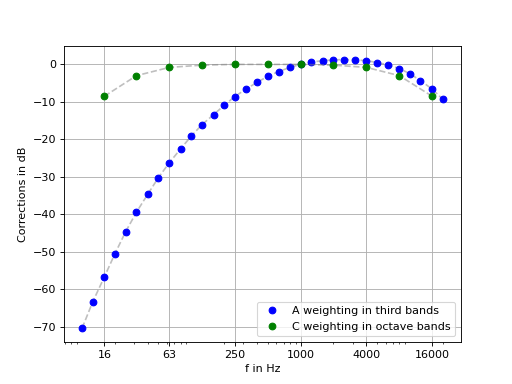
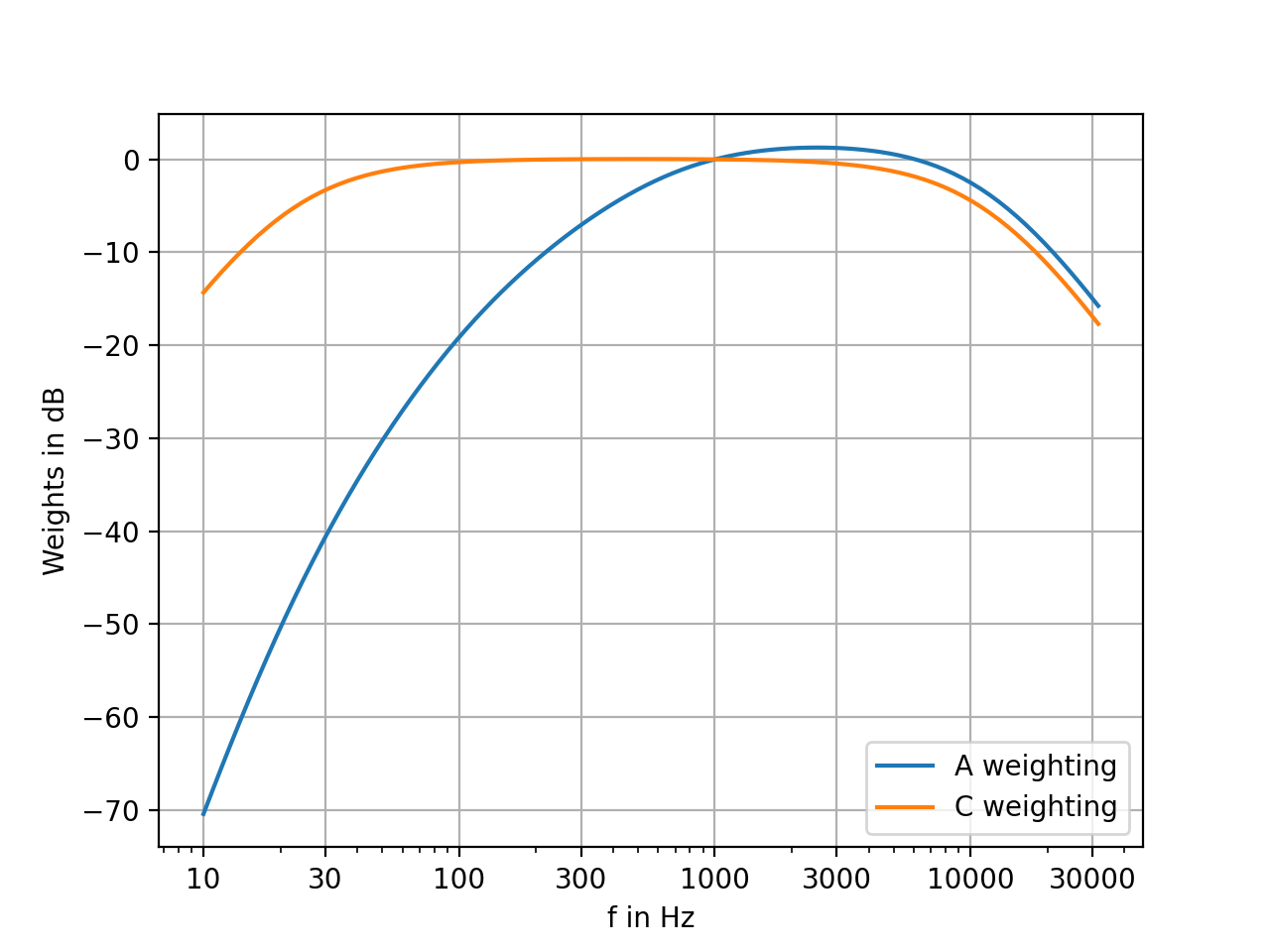
- pyfar.constants.frequency_weighting_curve(weighting: Literal['A', 'C'], frequencies: list[float])[source]#
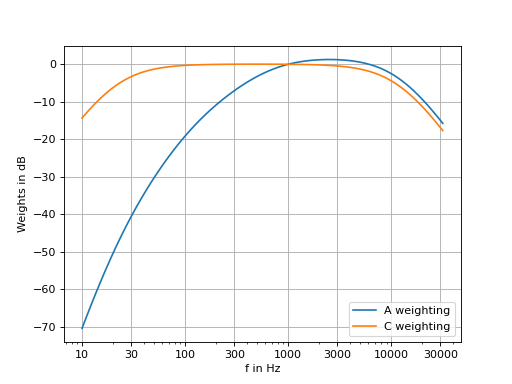
Calculates the level correction in dB of each frequency component when using the A or C frequency weighting.
- Parameters:
weighting (str ('A' or 'C')) – Which frequency weighting to use.
frequencies (array-like) – The frequencies at which to evaluate the weighting curve.
- Returns:
weights – The weights in dB in the same shape as frequencies. These weights are in accordance with IEC 61672-1 [15].
- Return type:
numpy.ndarray[float]
References
Examples
Plot the weighting curves.
>>> import pyfar as pf
>>> import matplotlib.pyplot as plt
>>> import numpy as np
>>> plot_frequencies = np.logspace(1, 4.5, 100, base=10)
>>> weights_A = pf.constants.frequency_weighting_curve(
...     "A", plot_frequencies)
>>> weights_C = pf.constants.frequency_weighting_curve(
...     "C", plot_frequencies)
>>> plt.plot(plot_frequencies, weights_A, label="A weighting")
>>> plt.plot(plot_frequencies, weights_C, label="C weighting")
>>> plt.semilogx()
>>> plt.xlabel("f in Hz")
>>> plt.ylabel("Weights in dB")
>>> ticks = [10, 30, 100, 300, 1000, 3000, 10000, 30000]
>>> plt.xticks(ticks, ticks)
>>> plt.grid()
>>> plt.legend()
(
Source code,png,hires.png,pdf)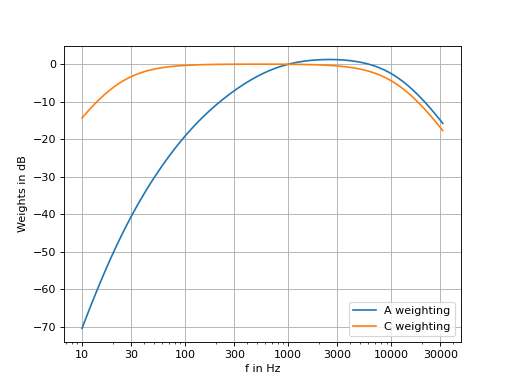
- pyfar.constants.saturation_vapor_pressure_magnus(temperature)[source]#
Calculate the saturation vapor pressure of water in Pascal using the Magnus formula.
The Magnus formula is valid for temperatures between -45°C and 60°C [16].
\[e_s = 610.94 \cdot \exp\left(\frac{17.625 \cdot T}{T + 243.04}\right)\]- Parameters:
temperature (float, array_like) – Temperature in degrees Celsius (°C).
- Returns:
p_sat – Saturation vapor pressure in Pa.
- Return type:
float, array_like
References
- pyfar.constants.speed_of_sound_cramer(temperature, relative_humidity, co2_ppm=425.19, atmospheric_pressure=None)[source]#
Calculate the speed of sound in air based on temperature, atmospheric pressure, humidity and CO2 concentration.
This implements Cramers method described in [17].
- Parameters:
temperature (float, array_like) – Temperature in degree Celsius from 0°C to 30°C.
relative_humidity (float, array_like) – Relative humidity in the range of 0 to 1.
co2_ppm (float, array_like, optional) – CO2 concentration in parts per million. The default is 425.19 ppm, based on [18]. Value must be below 10 000 ppm (1%).
atmospheric_pressure (float, array_like, optional) – Atmospheric pressure in Pascal, by default
reference_atmospheric_pressure. Value must be between 75 000 Pa to 102000 Pa.
- Returns:
speed_of_sound – Speed of sound in air in m/s.
- Return type:
float, array_like
References
- pyfar.constants.speed_of_sound_ideal_gas(temperature, relative_humidity, atmospheric_pressure=None, saturation_vapor_pressure=None)[source]#
Calculate speed of sound in air using the ideal gas law.
The speed of sound in air can be calculated based on chapter 6.3 in [19]. All input parameters must be broadcastable to the same shape.
- Parameters:
temperature (float, array_like) – Temperature in degree Celsius.
relative_humidity (float, array_like) – Relative humidity in the range of 0 to 1.
atmospheric_pressure (float, array_like, optional) – Atmospheric pressure in Pascal, by default
reference_atmospheric_pressure.saturation_vapor_pressure (float, array_like, optional) – Saturation vapor pressure in Pascal. If not given, the function
saturation_vapor_pressure_magnusis used. Note that the valid temperature range therefore also depends onsaturation_vapor_pressure_magnus.
- Returns:
speed_of_sound – Speed of sound in air in m/s.
- Return type:
float, array_like
References
- pyfar.constants.speed_of_sound_simple(temperature)[source]#
Calculate the speed of sound in air using a simplified version of the ideal gas law based on the temperature.
The calculation follows ISO 9613-1 [20] (Formula A.5).
\[c(t) = c_\text{ref} \cdot \sqrt{\frac{t - t_0}{t_\text{ref} - t_0}}\]- where:
\(t\) is the air temperature (°C)
\(t_\text{ref}=20\mathrm{°C}\) is the reference air temperature (°C), see
reference_air_temperature_celsius\(t_0=-273.15\) °C is the absolute zero temperature (°C), see
absolute_zero_celsius\(c=343.2\) m/s is the speed of sound at the reference temperature, see
reference_speed_of_sound
- Parameters:
temperature (float, array_like) – Temperature in degree Celsius from -20°C to +50°C.
- Returns:
speed_of_sound – Speed of sound in air in (m/s).
- Return type:
float, array_like
References